How to Set Up WeChat Pay (Step-by-Step)
- Download WeChat
- Create Your Account
- Access WeChat Pay
- Complete Identity Verification
- Add Your International Card
Frequently Asked Questions
Do I need a Chinese bank account?
No. For merchant payments (stores, restaurants, Didi, Meituan), a verified international card is enough. However, with a foreign card you cannot send person-to-person transfers, send or receive red packets (hongbao), or top up or withdraw an in-app balance. Those functions require a Chinese bank account with a UnionPay card — which also removes the 3% cross-border fee and raises your limits to domestic tier.
Do I need cash in China?
Yes, as a backup — but not much. Daily life runs on WeChat Pay and Alipay, yet cash remains the payment that works everywhere: small vendors, temples, street taxis, rural areas, and any moment your phone or app fails. Carry ¥300–500 in small notes (¥10–¥100). See the cash or card section for the full scenario breakdown.
Do taxis in China take cash?
Street-hailed taxis: usually yes — keep ¥10/¥20/¥50 notes handy since drivers often can't break a ¥100. App-hailed rides (Didi) are mobile-payment only. If you have any wallet set up, a driver's personal QR code works too.
Can I use my Visa or Mastercard directly in China?
Only in some places. Foreign Visa/Mastercard works at terminals displaying card-network logos — mostly international hotels, shopping malls, chains, and airport shops — and at bank ATMs for cash withdrawal. Street vendors, small restaurants, and taxis rarely take foreign cards. For the full acceptance picture, see using a foreign card directly.
Can I set this up before arriving in China?
Yes, and you should! Download the apps and complete as much verification as possible before your trip. This ensures you're ready on day one.
Is mobile payment safe in China?
Yes. Both WeChat Pay and Alipay use biometric authentication (fingerprint, Face ID), 6-digit payment passwords, real-time transaction alerts, and encrypted connections.
What if my phone battery dies?
Always carry a power bank (or rent a shared one almost anywhere in China — scan, charge, return). In emergencies, major hotels and some stores accept international credit cards (Visa/Mastercard), though acceptance is limited outside tourist areas.
Can I use Apple Pay or Google Pay in China?
Very limited. Apple Pay only works at mainland terminals with cards issued by mainland Chinese banks (UnionPay) added to Apple Wallet — a foreign-card Apple Pay or Google Pay wallet is essentially not accepted. Some foreign wallets (AlipayHK, Kakao Pay, Touch'n Go, and 30+ others) can scan Alipay/WeChat QR codes directly, and since May 2025 US PayPal users can scan WeChat merchant codes too. For daily use, though, stick with WeChat Pay and Alipay.
How do I get a refund?
Refunds go back to your original payment method (your international card). Processing time depends on your bank — typically 3–7 business days, up to 10 with smaller issuers.
Quick Summary: Foreigners can now use WeChat Pay and Alipay in China by linking international cards (Visa, Mastercard). No Chinese bank account required for basic payments. This guide walks you through setup, usage, and troubleshooting — plus when you still need cash, what to do without Alipay, and where your foreign card works directly.
Payments are the layer travelers feel most — the Chinese Internet Survival Guide covers them in sequence with connectivity, verification, and the essential apps.
Why Mobile Payment Matters in China
China is one of the most cashless societies in the world. In major cities like Shanghai, Beijing, and Shenzhen, over 90% of transactions are made via mobile payment.
Without WeChat Pay or Alipay, you may face difficulties:
- Many small vendors don’t accept cash or cards
- Taxi apps (Didi) require mobile payment
- Food delivery services only work with mobile wallets
- Some restaurants only have QR code menus linked to payment
Good news: Since July 2023, both WeChat Pay and Alipay officially support international cards from foreigners — and since March 2024, the People’s Bank of China has raised the spending caps for foreign cards significantly (single transactions up to ~$5,000 USD and ~$50,000 per year once you verify your passport).
WeChat Pay vs Alipay: Which One to Choose?
| Feature | WeChat Pay | Alipay |
|---|---|---|
| Acceptance | Slightly higher in small shops | Slightly higher in online services |
| Setup Difficulty | Easy | Easy |
| English Interface | Yes | Yes |
| International Card Support | ✅ Yes | ✅ Yes |
| Transport Integration | Good | Better (includes metro in more cities) |
Our Recommendation: Set up both apps before arriving. Use whichever works at the merchant. They’re both widely accepted.
Short trip and don’t want the full setup? Since September 2026 there’s a lighter option: TenPayGo, WeChat Pay’s standalone app for visitors. It registers with just an email address — no Chinese phone number, no full WeChat account — and pays at the same WeChat Pay merchants, with an AI translator and a Shenzhen transit card bundled in.
What You Need Before You Start
Before setting up mobile payments, prepare the following:
Required Items
| Item | Notes |
|---|---|
| Passport | For identity verification (photo page) |
| International Card | Visa, Mastercard, JCB, Amex, Discover, Diners Club, or UnionPay cards issued outside mainland China |
| Working Phone Number | For receiving SMS verification codes |
| Stable Internet | Wi-Fi or roaming data to complete setup |
Important Tips Before You Travel
- Call your bank before departure — inform them you’ll be using your card in China to prevent fraud blocks
- Enable international transactions on your card
- Download apps before arrival — Google Play is blocked in China, App Store works but can be slow
- Prepare some cash (200-500 CNY) as backup for initial days — see cash or card below for when you’ll actually need it
How to Set Up WeChat Pay (Step-by-Step)
Step 1: Download WeChat
- iOS: App Store
- Android: Google Play (download before arriving in China)
Step 2: Create Your Account
- Open WeChat and tap “Sign Up”
- Enter your phone number (use your home country number)
- Verify via SMS code
- Set your profile name and password
Step 3: Access WeChat Pay
- Go to Me → Services → Wallet
- If you don’t see Wallet, tap “Enable Payment”
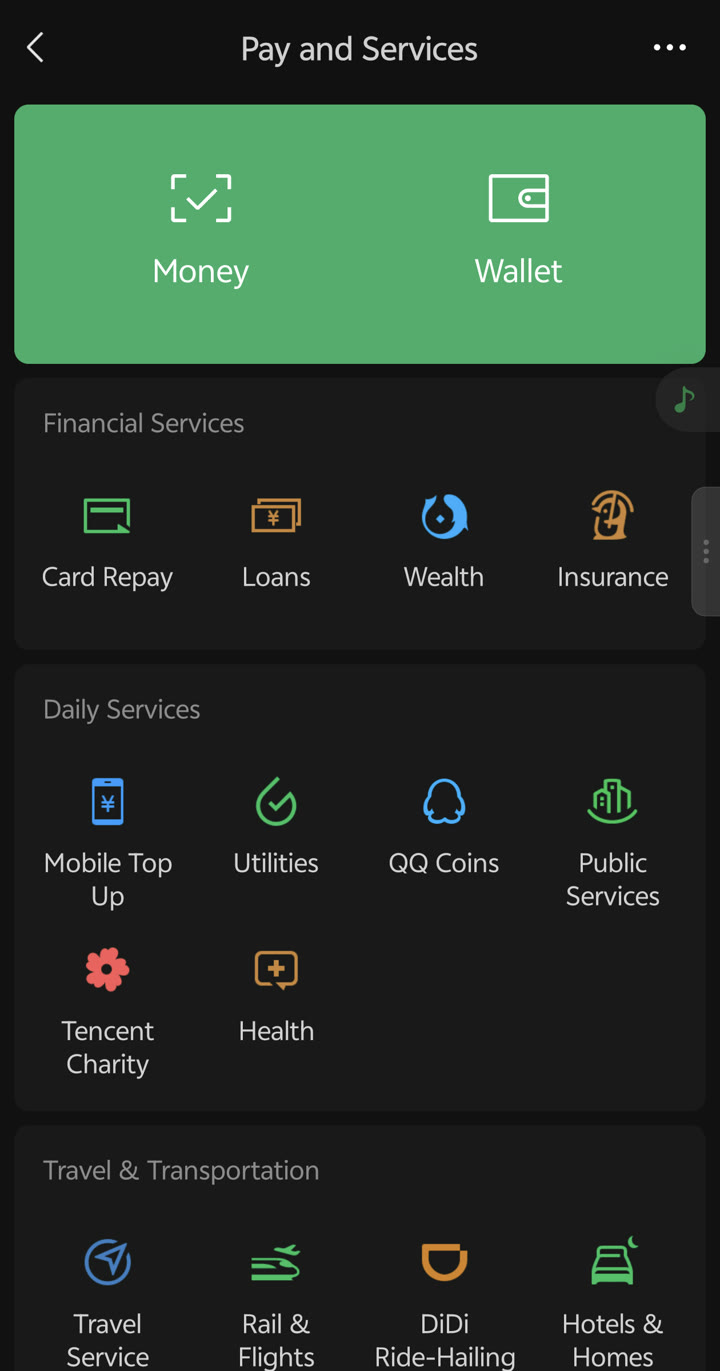 WeChat Pay and Services portal: quick access to Money (QR payment code), Wallet, and daily transport services.
Step 4: Complete Identity Verification
- Tap “Verify Identity”
- Select “I don’t have a mainland ID”
- Choose your passport-issuing country
- Enter your passport details exactly as shown on your passport
- Take a selfie for facial recognition
- Wait for verification (usually instant, sometimes 1-2 days)
Step 5: Add Your International Card
- In Wallet, tap “Cards” → “Add Card”
- Select “International/HK/Macau/Taiwan Card”
- Enter your card details (number, expiry, CVV)
- Verify via SMS from your bank
- Set a 6-digit payment password
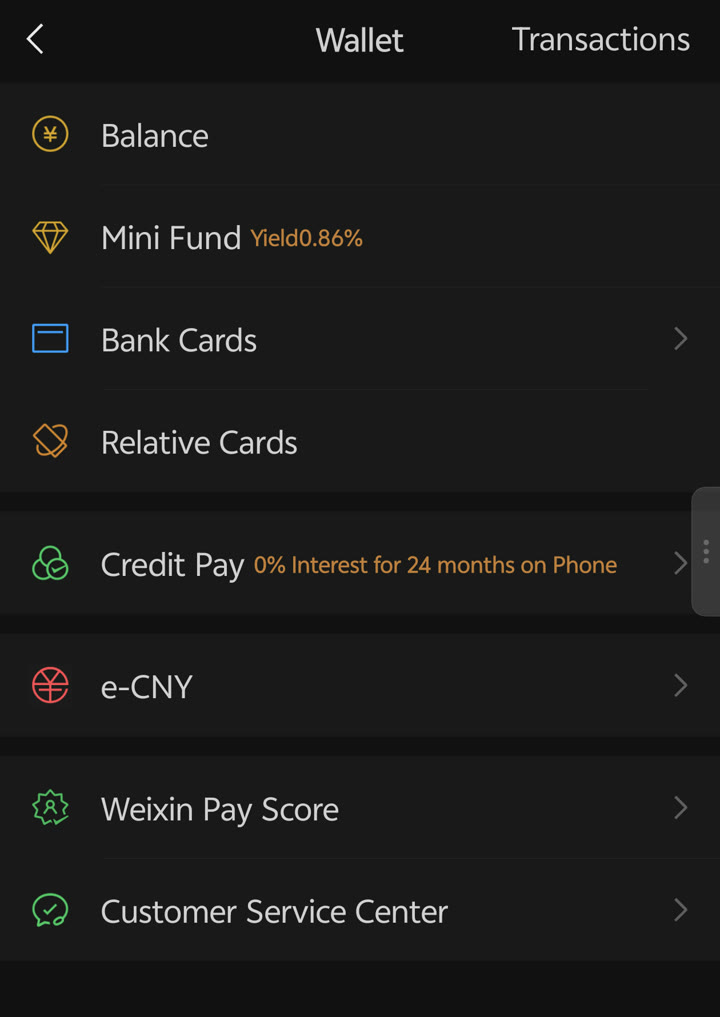 WeChat Wallet screen: tap “Bank Cards” to link international cards or “ID Info” at the bottom for identity verification.
✅ Done! Your WeChat Pay is ready to use.
Note: WeChat may require an existing WeChat user to scan your QR code for verification. If you don’t know anyone in China, try asking hotel staff or a friendly local.
How to Set Up Alipay (Step-by-Step)
Step 1: Download Alipay
- iOS: App Store
- Android: Google Play
Step 2: Register Your Account
- Open Alipay and select “International” version
- Tap “Sign Up”
- Enter your phone number and verify via SMS
- Set a login password
Step 3: Complete Identity Verification
- Go to “Me” → “Settings” → “Account & Security”
- Tap “Identity Verification”
- Select “International User”
- Upload your passport photo (photo page)
- Complete facial recognition
- Wait for approval (usually within minutes)
Step 4: Add Your International Card
- Go to “Me” → “Bank Cards”
- Tap ”+ Add”
- Select “International Card”
- Enter card details
- Agree to terms and verify
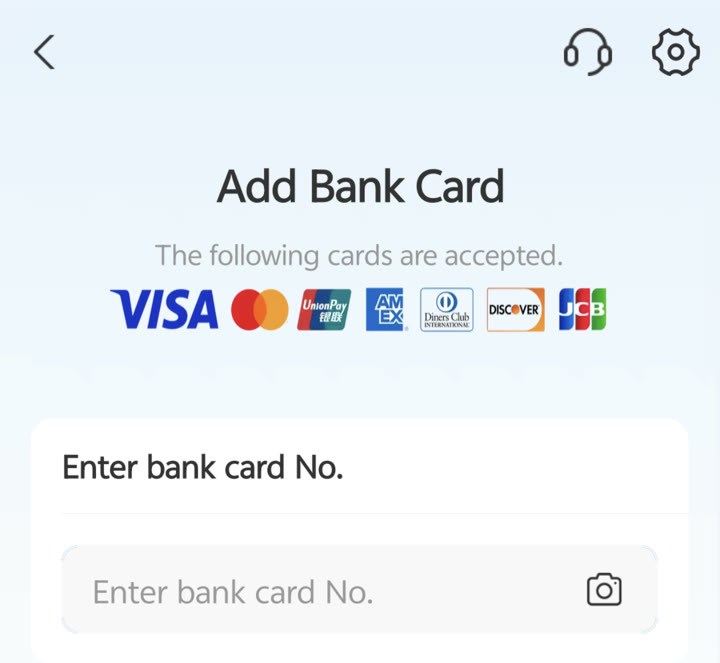 Alipay international card binding interface supporting Visa, Mastercard, Diners Club, Discover, and JCB.
✅ Done! Your Alipay is ready to use.
How to Make Payments in China
Method 1: Scan to Pay (Most Common)
- Open WeChat/Alipay
- Tap “Scan” (camera icon)
- Scan the merchant’s QR code
- Enter the payment amount
- Enter your payment password
- Done!
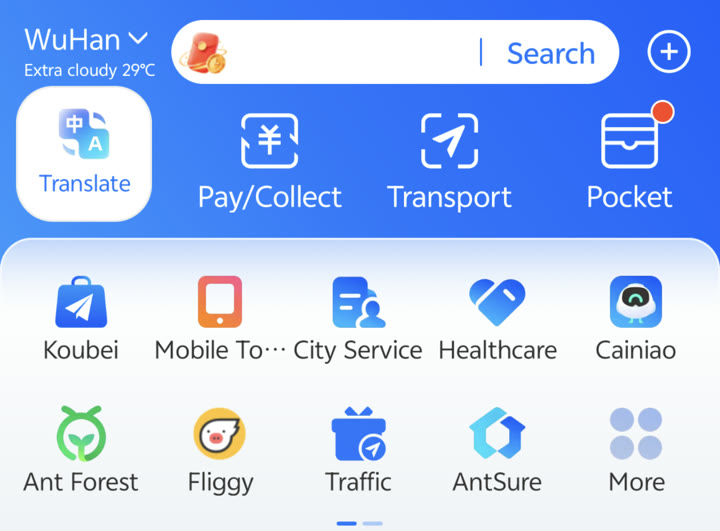 Alipay home interface: tap “Scan” on the top left to scan merchant QR codes or “Pay / Receive” to present your payment code.
Method 2: Show Your QR Code
- Open WeChat/Alipay
- Tap “Pay” or “Payment Code”
- Show your QR code to the merchant
- They scan your code
- Transaction complete!
Method 3: In-App Payments
For online services (Didi, Meituan, etc.):
- Select your item/service
- Choose WeChat Pay or Alipay at checkout
- Confirm with password or Face ID
- Done!
Cash or Card in China: When You Still Need Cash
Verdict: In 2026, China runs on QR codes — but cash still works everywhere, and you should carry some. Set up mobile payment as your main method (walkthroughs above), then keep a few hundred yuan in small notes as the backup that never fails: dead phone battery, failed verification, tiny vendors, temples, taxis, and anywhere the QR code isn’t happening. RMB is legal tender, so businesses are generally expected to accept it — outright refusal is uncommon, though some cashless-leaning stalls quietly prefer QR.
Information as of September 2026. Fee rates and transaction limits live separately in Transaction Limits and Fees below.
Where each payment method actually works
| Situation | WeChat Pay / Alipay | Foreign card direct | Cash |
|---|---|---|---|
| Street vendors & markets | Usually | Rarely | Always works |
| Convenience stores & chain restaurants | Yes | Sometimes | Yes |
| Street-hailed taxis | Usually (QR) | Rarely | Usually — small notes |
| Didi (app-hailed rides) | Yes | No | No |
| Temples & small attractions | Usually | Rarely | Yes — small notes preferred |
| Hospitals & pharmacies | Usually | Varies | Yes |
| High-end hotels & big malls | Yes | Often — look for card logos | Yes |
| Rural areas & family-run shops | Sometimes | Rarely | Essential |
Typical acceptance in 2026 based on current traveler reports; individual merchants vary.
How much cash should you carry?
- City trip: ¥300–500 in mixed small notes (¥10/¥20/¥50/¥100) covers taxis, snacks, and tickets for days
- Small notes matter: taxi drivers and stall owners often can’t break a ¥100
- Heading rural: add a buffer — smaller towns lean harder on cash, especially at markets
- Running low: withdraw from bank ATMs (see foreign card acceptance) or exchange at bank branches with currency-exchange signs; airport counters work but at worse rates
- Staying 2+ weeks? A local bank account removes cash friction entirely — see how to open a bank account in China
Typical Daily Costs in China (2026)
Verdict: a comfortable tourist day in China costs less than you’d expect — street food and metro make ¥30–90 days entirely normal, and even restaurant-heavy days land around ¥100–220 before lodging. Every price below is quoted in one of our own guides, so treat this as a consistency-checked snapshot rather than a survey; tier-1 cities trend above the food figures, which come from our Wuhan guide.
What things cost (from our guides)
| Thing | Price | Quoted in |
|---|---|---|
| Street breakfast (Wuhan hot dry noodles) | ¥6–12 | Wuhan food guide |
| Budget restaurant meal (campus areas) | ¥10–30 per person | Wuhan food guide |
| Mid-range restaurant dish | ¥15–40 per portion | Wuhan food guide |
| Food delivery | ¥3–6 fee, ¥15–30 minimum order | Meituan guide |
| Metro ride | ¥2–10 | Metro guide |
| Transit card deposit | ¥20 (refundable) | Metro guide |
| Local SIM with +86 number | ¥50–150 starter, ~¥100–200/month | Phone number guide |
| Small-city hotel night | Under ¥200 | Hotel booking guide |
Lodging beyond the small-city anchor varies too widely to range here — the hotel booking guide covers it. Ride-hailing fares aren’t tabled because our DiDi guide doesn’t quote flat figures; see it for how fares are metered.
Three realistic days (excluding lodging)
Same Light/Medium/Heavy style we use for eSIM data — each total is just the quoted unit prices added up:
| Profile | What the day looks like | Variable spend |
|---|---|---|
| Light — street food & metro | Street breakfast ¥6–12 + two budget meals ¥20–60 + metro rides ¥4–20 | ≈ ¥30–90/day |
| Medium — restaurants & delivery | Breakfast ¥6–12 + mid-range dish ¥15–40 + budget dinner ¥10–30 + one delivery order ¥18–36 + metro ¥4–20 | ≈ ¥55–140/day |
| Heavy — sit-down meals, max distances | Three restaurant meals ¥45–120 + delivery extras ¥36–72 + metro at maximum fares ¥10–30 | ≈ ¥90–220/day, before any taxis |
Connectivity across all three: a local SIM runs ¥100–200 for a month, ≈¥3–7/day. Taxis and DiDi add on top of these totals — our DiDi guide covers the app; the cash section above covers the notes to carry.
Paying in China Without Alipay: Your Options
Verdict: Yes, you can manage without Alipay — WeChat Pay alone covers most of it, and cash covers the rest. Alipay is the more complete tourist wallet (better transport integration, wider online coverage), but it is not mandatory. Three workable paths:
| Path | What you need | Works for | Main friction |
|---|---|---|---|
| WeChat Pay only | Passport + international card in WeChat | Street vendors, taxis, Didi, most shops | Some online services and metro integrations are Alipay-first. Setup: WeChat Pay for foreigners |
| Cash only | RMB notes in small denominations | Everything face-to-face | No QR menus, no Didi, no food delivery; change is hard for big notes |
| Foreign card direct swipe | Visa/Mastercard/UnionPay card | High-end hotels, malls, chains (see below) | A minority of merchants; useless at street level |
If you reconsider, the Alipay setup guide and the Alipay steps above have you covered in 15 minutes. Card getting declined in either app? Go straight to the fix guides: Alipay foreign card not working or WeChat Pay not working for foreigners.
Neither app set up yet? Your day-one emergency plan
- Withdraw RMB from a bank ATM with your foreign card — major banks (ICBC, BOC, CCB) accept international cards at logo-marked ATMs
- Pay cash for taxis, food, and tickets — small notes
- Charge big expenses to your card at hotel front desks — international-chain hotels routinely take Visa/Mastercard
- Ask hotel staff for verification help — WeChat’s “existing user scan” workaround is standard concierge territory; see WeChat verification without a friend
- Finish app setup properly — the WeChat and Alipay walkthroughs above take 15–30 minutes with a stable connection
Using a Foreign Card Directly: Where It Works
Verdict: Your Visa/Mastercard works in China — but only at a minority of terminals, and mostly at the top end. The official rule of thumb: foreign cards are accepted wherever the checkout displays UnionPay, Visa, or Mastercard logos; no logo, assume no — ask the cashier before you order. One exception: UnionPay cards issued outside mainland China work at essentially any mainland POS terminal.
Information as of September 2026 (acceptance guidance published by the Shanghai government, updated July 2026).
Where foreign cards are typically accepted
| Acceptance | Merchant types |
|---|---|
| Usually yes | International-chain hotels, large shopping malls, department stores, upscale restaurants, airport shops, major tourist attractions |
| Hit-or-miss | Mid-range restaurants, local chain stores, pharmacies, smaller attractions |
| Usually no | Street vendors, markets, small family restaurants, most taxis, temples |
ATM withdrawals with a foreign card
- Use bank ATMs showing your card’s network logo (ICBC, BOC, CCB are the most foreigner-friendly); avoid standalone machines in shops
- Per-withdrawal cap: usually around ¥3,000 per transaction at Chinese ATMs (official guidance); your own bank may set lower daily limits — check before you fly
- Fees: some operators add ¥20–30 per withdrawal (varies by machine), plus your issuing bank’s cash-withdrawal/foreign-transaction fee (typically 1–3%) — separate from the wallet fees in limits and fees
- Always choose to be charged in CNY when the ATM offers your home currency — dynamic currency conversion (DCC) adds a hidden markup
- Card declined even at the ATM? That’s an issuer/card-enabling issue — the foreign card troubleshooting guide covers each failure stage
Transaction Limits and Fees
Limits (International Cards)
The caps were raised in March 2024 under the State Council/PBOC payment-facilitation measures, and they apply to both apps once you complete passport identity verification:
| Limit Type | Cap (Verified Users) |
|---|---|
| Per Transaction | Up to |
| Annual Cumulative | |
| Without Passport Verification | Up to $2,000 ceiling (risk controls often allow less) |
In practice the two apps behave differently near the ceiling: Alipay commonly clears single charges up to roughly ¥35,000 on fully verified accounts, while WeChat Pay keeps its own lower per-transaction tier (around ¥6,000) for many foreign-card users. Daily sub-caps exist but are rarely published — commonly around ¥10,000–20,000 and they move with your account’s risk profile. Before a big purchase (hotel block, electronics), check your own ceiling in-app: WeChat → Me → Services → Wallet → Help/Limits; Alipay → limits shown at payment failure or in account settings.
Fees — the ¥200 Rule (Changed!)
This is the fee structure most outdated guides get wrong:
- Payments of ¥200 or less: 0% platform fee
- Payments over ¥200: a 3% cross-border service fee applies — charged on the whole amount, not just the excess (a ¥600 dinner costs ¥18 in fees)
- Both WeChat Pay and Alipay have used this structure since 2023; new users sometimes get temporary fee-waiver promos (e.g., fee-free payments up to ~¥1,000 during an initial window) — check in-app for current offers
- On top of that, your issuing bank may add its own foreign transaction fee (typically 1–3%)
How to blunt the fee:
- Ask the merchant to split large bills into sub-¥200 payments where practical
- Use a no-foreign-transaction-fee card (Wise, Revolut, etc.) so you only pay the 3%
- Staying 2+ weeks? Open a Chinese bank account — a domestic UnionPay card has no 3% fee, higher limits, and unlocks transfers
Common Issues and Solutions
“Card Declined” or “Payment Failed”
Solutions:
- Call your bank to enable international transactions
- Try a different card
- Check if you’ve hit the per-transaction or annual limit
- Ensure card has sufficient balance
For deeper diagnosis, the dedicated fix guides cover each failure stage: Alipay foreign card not working (linking and payment failures) and WeChat Pay not working for foreigners (tiers, restrictions, risk control).
Identity Verification Failed
Solutions:
- Ensure name matches passport exactly (including middle name)
- Retake passport photo in good lighting
- Try again after 24 hours
Can’t Find “Wallet” or “Pay” Option
Solutions:
- Update app to latest version
- Change app region to China in settings
- Complete identity verification first
“Need Existing User to Verify” (WeChat)
Solutions:
- Ask a friend who uses WeChat to scan your code
- Ask hotel staff or tour guide
- Try setting up in a WeChat-friendly country first
Related Guides
- First Week in China Checklist — Your full arrival setup plan, day by day
- VPN for China 2026 — Set up before arrival; VPN websites are blocked in China
- Is Healthcare in China Free? — What to expect for medical costs
- Medical Trip to China: Practical Overview — Planning your medical travel
- Expat Medical Insurance in China — Coverage options for foreigners
- Renting an Apartment in China — Paying rent and deposits as a foreigner
Summary: Quick Checklist
Before your trip:
- Download WeChat and Alipay
- Complete identity verification
- Link your international card
- Inform your bank about China travel
- Prepare 200-500 CNY cash as backup
You’re ready to pay in China!
Need Help? Check our other Living Guides or contact us.